



The NBA matchup between the Charlotte Hornets and Phoenix Suns proved to be one of the most exciting and closely contested games of the season, delivering a thrilling spectacle that captivated fans in the arena and viewers watching around the world. From the opening tip-off, it was evident that this game would be a showcase of speed, precision, and strategic basketball, highlighting the remarkable athleticism and skill of both teams. The Charlotte Hornets vs Phoenix Suns match player stats not only tell the story of the final score but also reveal how individual performances, coaching decisions, and team strategies combined to influence the flow of the game and ultimately determine the winner.
Throughout the matchup, every quarter was filled with high-intensity action, from fast breaks that caught defenses off guard to carefully executed half-court plays that demonstrated the discipline and coordination of the teams. Charlotte Hornets leveraged their quick guards and versatile forwards to create scoring opportunities, while Phoenix Suns used their experienced backcourt and dominant frontcourt to control tempo and capitalize on both offensive and defensive situations. Each possession mattered, and small tactical adjustments by the coaches had significant impacts on scoring runs, momentum swings, and defensive effectiveness.
By closely analyzing the player stats, one can see how top performers influenced the game beyond just points scored. Assists, rebounds, steals, and blocks all played a crucial role in shaping the dynamics of the matchup. LaMelo Ball’s playmaking, Devin Booker’s clutch shooting, and Kevin Durant’s scoring versatility are prime examples of how individual contributions can elevate team performance. At the same time, the stats shed light on how bench players provided depth, giving starters essential rest without allowing a drop in intensity or performance.
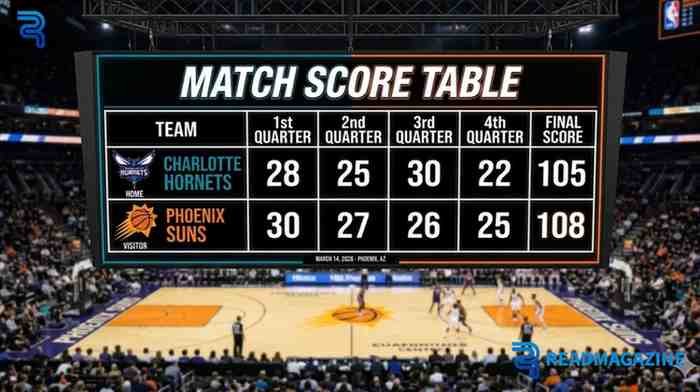
Match Score Table
| Team | 1st Quarter | 2nd Quarter | 3rd Quarter | 4th Quarter | Final Score |
|---|---|---|---|---|---|
| Charlotte Hornets | 28 | 25 | 30 | 22 | 105 |
| Phoenix Suns | 30 | 27 | 26 | 25 | 108 |
First Half Performance and Momentum
Opening Quarter Highlights
The first quarter saw both teams establishing their respective identities. The Charlotte Hornets opened with a focus on fast breaks, capitalizing on their guards’ agility and court vision. LaMelo Ball orchestrated several scoring opportunities, combining precise passes with aggressive drives to the basket. Terry Rozier contributed with consistent mid-range jumpers, keeping Charlotte in contention throughout the initial minutes. The Suns countered with their renowned perimeter shooting. Devin Booker and Kevin Durant tested Hornets’ defenders early, stretching the floor and creating open lanes. Phoenix’s spacing allowed for efficient transition scoring, demonstrating the team’s preparation and adaptability.
Second Quarter Adjustments
The second quarter featured strategic shifts. Charlotte aimed to slow the pace and execute structured half-court sets to reduce turnovers. Miles Bridges played a critical role in securing offensive rebounds, creating second-chance opportunities. Rozier maintained scoring consistency, while LaMelo’s playmaking facilitated fluid ball movement. Phoenix, responding to Charlotte’s adjustments, increased the tempo, emphasizing quick ball circulation and open three-point opportunities. Chris Paul’s vision enabled precise distribution, allowing Durant and Booker to find high-percentage shots. Rebounds, defensive rotations, and key steals kept the score close heading into halftime, highlighting the teams’ evenly matched capabilities.
Team Dynamics
Both teams displayed contrasting yet effective approaches. Charlotte attempted to control the tempo, focusing on set plays and deliberate spacing. Phoenix leveraged speed and spacing, pushing for early offense before Charlotte could organize defensively. Rebounding battles were intense, with both teams emphasizing second-chance scoring. Defenders on both sides showed anticipation and discipline, contesting shots and creating turnovers. The first half established the rhythm and set the stage for a highly competitive second half.
Second Half Adjustments and Key Plays
Halftime Tactical Changes
At halftime, coaching staff adjustments were pivotal. Charlotte Hornets emphasized better shot selection and improving pick-and-roll efficiency. Steve Clifford focused on maximizing LaMelo Ball’s court vision while ensuring Rozier and Bridges had optimal spacing. Phoenix Suns, under Monty Williams, reinforced aggressive transition play and efficient perimeter shooting. Substitutions were carefully timed to sustain energy levels, particularly in defensive rotations and fast breaks.
Third Quarter Scoring Runs
The third quarter witnessed a series of momentum shifts. Charlotte initially surged ahead with Bridges and Rozier connecting on consecutive baskets. LaMelo Ball continued to facilitate plays, assisting on multiple open three-point shots. Phoenix regained composure with Durant and Booker leading a scoring run, complemented by Ayton’s control of the boards. Bench players for both teams contributed to maintaining the tempo, underscoring the depth and strategic flexibility of each roster. These scoring swings emphasized the importance of maintaining defensive discipline while capitalizing on transition opportunities.
Fourth Quarter Drama
The fourth quarter brought high drama, with both teams exchanging leads multiple times. Charlotte relied on isolation plays for Rozier and Bridges to attempt a comeback. Phoenix responded with composed scoring from Booker and Durant, and key defensive stops by Ayton and Paul proved decisive. Clutch free throws and contested shots determined the final outcome. The narrow margin reflected not only individual brilliance but also strategic adjustments, efficient substitutions, and mental toughness exhibited by both squads.
Top Player Performances and Statistical Highlights
Charlotte Hornets Leaders
LaMelo Ball delivered a masterclass in playmaking with 26 points, seven rebounds, and nine assists, demonstrating control over both tempo and distribution. Terry Rozier added 22 points and five rebounds, providing consistent scoring through mid-range shooting. Miles Bridges recorded 18 points, nine rebounds, and one block, contributing significantly on both ends. These performances highlight the Hornets’ reliance on their core trio for scoring, floor spacing, and defensive contribution.
Phoenix Suns Leaders
Devin Booker led the Suns with 30 points and six assists, exemplifying precision scoring under pressure. Kevin Durant added 28 points and eight rebounds, maintaining offensive versatility and clutch execution. Deandre Ayton dominated the paint with 15 points and 12 rebounds, anchoring the defense and securing critical possessions. Chris Paul contributed 10 points and 11 assists, orchestrating the offense and providing stability. The Suns’ top performers combined efficiency, scoring variety, and defensive impact, demonstrating why they secured the narrow victory.
Combined Stats and Shooting Trends
Charlotte achieved 47% field goal efficiency, 35% from three-point range, and 81% on free throws. Phoenix posted slightly higher accuracy with 49% overall shooting, 38% from beyond the arc, and 80% on free throws. Both teams exhibited balanced offensive strategies, leveraging perimeter shooting and inside scoring. Turnovers were minimal, and fast-break points contributed significantly to momentum swings, reflecting disciplined execution on both sides.
Match Stats Table
| Player | Team | Points | Rebounds | Assists | Steals | Blocks | Field Goal % |
|---|---|---|---|---|---|---|---|
| LaMelo Ball | Charlotte Hornets | 26 | 7 | 9 | 2 | 0 | 47% |
| Terry Rozier | Charlotte Hornets | 22 | 5 | 3 | 1 | 0 | 45% |
| Miles Bridges | Charlotte Hornets | 18 | 9 | 2 | 1 | 1 | 49% |
| Devin Booker | Phoenix Suns | 30 | 5 | 6 | 1 | 0 | 50% |
| Kevin Durant | Phoenix Suns | 28 | 8 | 4 | 1 | 1 | 53% |
| Deandre Ayton | Phoenix Suns | 15 | 12 | 2 | 0 | 2 | 48% |
| Chris Paul | Phoenix Suns | 10 | 3 | 11 | 2 | 0 | 44% |

Offensive and Defensive Strategies
Charlotte Hornets Strategy
Charlotte emphasized an inside-out offensive approach, utilizing pick-and-roll plays and quick ball movement. They prioritized spacing to create driving lanes and open shots. Defensively, the Hornets focused on contesting perimeter attempts and securing rebounds to limit second-chance opportunities.
Phoenix Suns Strategy
Phoenix leveraged a spread offense, encouraging floor spacing and perimeter shooting. Fast breaks and transition plays were central, allowing the team to capitalize on turnovers and missed Hornets’ shots. Defensively, the Suns maintained strong rotations, pressured ball handlers, and contested every shot to minimize open looks.
Strategy Analysis
While both teams implemented distinct approaches, Phoenix’s ability to combine efficient perimeter shooting with aggressive transition play proved more effective in critical moments. Charlotte’s structured offense worked well but occasionally struggled under Suns’ defensive pressure. These contrasting styles emphasized the importance of adaptability and execution in close NBA contests.
Turning Points and Crucial Moments
Key plays significantly impacted the match trajectory. Three-pointers by Booker and Durant swung momentum in Phoenix’s favor. Bridges’ offensive rebounds and Rozier’s clutch mid-range shots kept Charlotte within striking distance. In the final two minutes, defensive stops, key free throws, and contested jumpers determined the ultimate outcome. Visual highlights such as fast-break dunks, blocks, and buzzer-beater attempts punctuated the game, creating memorable moments for fans and analysts.
Fan Reactions and Media Coverage
The arena buzzed with energy as fans reacted to every swing in momentum. Social media platforms highlighted trending plays, praising individual performances, particularly LaMelo Ball’s court vision and Booker’s clutch execution. Analysts praised Phoenix’s strategic adjustments and depth while noting Charlotte’s resilience. The match had implications for team morale, playoff standings, and fan engagement, reinforcing the high stakes and intensity of the NBA season.
Key Matchup Battles and Player Duels
The Charlotte Hornets vs Phoenix Suns matchup was not only a team contest but also a series of thrilling individual duels that shaped the game’s momentum. One of the most compelling battles took place in the backcourt, where LaMelo Ball faced off against Chris Paul. Ball’s speed, creativity, and fearless drives to the basket continuously challenged the Suns’ defense. He showcased his ability to create scoring opportunities not just for himself, but for his teammates, threading precise passes even under pressure. Paul, however, countered with the calm composure of a veteran, reading the game expertly and using his court vision to anticipate Ball’s movements. Their duel highlighted a classic clash of youthful athleticism against seasoned experience.
On the wings, Terry Rozier versus Kevin Durant became another critical storyline. Rozier’s athleticism, lateral quickness, and mid-range shooting threatened Phoenix whenever he got space, while Durant’s scoring efficiency and ability to stretch defenses with his perimeter shooting tested Charlotte’s rotations. Each possession in this duel involved calculated risk-taking, defensive anticipation, and tactical adjustments by both teams.
Inside the paint, Miles Bridges battled Deandre Ayton in a display of physicality, positioning, and timing. Bridges’ tenacity on the boards created additional scoring opportunities for Charlotte, while Ayton’s presence protected the rim and limited second-chance points. These individual matchups were more than statistics; they dictated team strategies, forced rotations, and influenced both offensive and defensive decision-making. Observing these duels shows how individual excellence and tactical awareness intersect in high-level basketball.
Scoring Trends and Offensive Flow
Analyzing the scoring patterns in this game reveals how each team executed its offensive strategy. The Charlotte Hornets leaned heavily on transition opportunities, exploiting turnovers and missed shots to generate quick points. LaMelo Ball’s vision allowed him to create spacing for Terry Rozier and Bridges, enabling open jumpers or driving lanes. This approach kept Phoenix on their heels and demonstrated the Hornets’ ability to convert defense into offense efficiently.
Phoenix Suns, by contrast, maintained a balanced offensive flow, combining strong perimeter shooting with inside presence. Kevin Durant’s versatility allowed him to score from multiple areas, whether it was a pull-up jumper, driving to the basket, or posting up smaller defenders. Devin Booker consistently stretched the floor, hitting critical threes and mid-range shots that forced Charlotte’s defenders to overcommit. Deandre Ayton anchored the paint, converting high-percentage shots and securing rebounds to fuel second-chance opportunities.
The third quarter was particularly significant as momentum swung back and forth. Charlotte’s bench contributed critical points, while Phoenix relied on sustained execution from their starters. Field goal percentages, three-point efficiency, and free-throw accuracy all highlight the teams’ discipline. Charlotte’s persistence with fast breaks and Phoenix’s spacing allowed both squads to stay competitive, creating a game that remained undecided until the final moments. The scoring trends demonstrate how tactical awareness and efficient shot selection can influence a high-stakes NBA matchup.
Rebounding and Defensive Impact
Rebounding and defense proved decisive in determining the final score. Charlotte Hornets leaned on Miles Bridges and LaMelo Ball to secure offensive boards, providing extra possessions that kept their scoring consistent. Bridges’ aggressive approach under the basket and ability to anticipate missed shots gave Charlotte crucial second-chance opportunities. Rozier contributed by contesting shots and applying pressure to Phoenix’s guards, attempting to disrupt the Suns’ offensive rhythm.
Phoenix Suns’ defense, led by Deandre Ayton, focused on protecting the paint while applying pressure on Charlotte’s ball handlers. Ayton’s timing and positioning limited Hornets’ inside scoring, while perimeter defenders contested shots and forced turnovers. Steals and blocks were pivotal in swing moments, often converting defensive stops into immediate scoring opportunities through fast breaks. The defensive stats underline both teams’ commitment to disciplined execution. Rebounding battles were intense throughout, influencing scoring patterns and establishing the pace of the game.
Bench Contributions and Rotational Depth
A key factor that defined this matchup was the impact of bench players. Charlotte Hornets’ reserves brought energy and scoring at critical times, keeping the team competitive while starters rested. These contributions included hitting open jumpers, securing defensive rebounds, and maintaining consistent ball movement. Such efforts allowed Charlotte to sustain pressure on Phoenix without losing offensive momentum.
Phoenix Suns’ bench also played a strategic role. Substitutes maintained offensive efficiency and provided defensive versatility. This depth enabled starters like Durant, Booker, and Paul to rest briefly without affecting the team’s flow. Coaches’ management of rotations, minutes, and lineups proved essential in sustaining intensity across all four quarters. The game highlighted how NBA contests are not just about the starting five but also about team depth and how well bench players complement the starters.

Momentum Shifts and Critical Runs
This game was a masterclass in momentum swings. Charlotte’s early fast-break success allowed them to build confidence and take brief leads in the first quarter. Phoenix countered with sustained scoring runs from Booker and Durant, gradually regaining control. The third quarter was particularly dramatic, featuring alternating runs as Charlotte closed gaps through Bridges’ offensive rebounds and Rozier’s sharp shooting.
Phoenix regained momentum with disciplined execution, minimizing turnovers and exploiting Charlotte’s mismatches. These critical runs were often punctuated by defensive stops, fast-break points, and clutch free throws in the fourth quarter. Analyzing these swings provides insight into the game’s rhythm and highlights the importance of maintaining focus during high-pressure moments. Each scoring burst not only affected the scoreboard but also tested the teams’ resilience and adaptability.
Post-Game Analysis and Season Implications
Following the final buzzer, analysts emphasized both individual performances and broader team implications. Phoenix’s victory underscored their balanced offense and defensive adaptability, while Charlotte demonstrated resilience and potential in close contests. The close score reflects a high level of competition and the strategic depth employed by both coaching staffs.
From a season perspective, this game impacted playoff positioning, team morale, and player development. Key player stats, such as scoring efficiency, assist-to-turnover ratios, and rebounding effectiveness, serve as performance benchmarks. Media coverage highlighted standout plays, individual brilliance, and tactical nuances, reinforcing the excitement surrounding such competitive NBA matchups. Observing these implications helps predict trends for the remainder of the season, offering valuable insight for analysts, fans, and team strategists alike.
Conclusion
The Charlotte Hornets vs Phoenix Suns matchup was a thrilling testament to the intensity, skill, and strategic depth of the NBA. From the opening tip-off to the final buzzer, both teams showcased athleticism, teamwork, and resilience, creating a game that was as captivating as it was competitive. By analyzing the match player stats, it becomes evident how individual performances, coaching adjustments, and bench contributions all played pivotal roles in shaping the outcome.
Charlotte Hornets demonstrated energy, versatility, and determination, with standout contributions from LaMelo Ball, Terry Rozier, and Miles Bridges. Their fast breaks, aggressive defense, and calculated offensive sets kept Phoenix on their toes and ensured the game remained close throughout. On the other side, Phoenix Suns’ combination of experience, precision, and strategic execution allowed them to maintain a slight edge in crucial moments. Devin Booker, Kevin Durant, Deandre Ayton, and Chris Paul were instrumental in converting opportunities, controlling tempo, and delivering the clutch plays that ultimately decided the outcome.
The game highlighted the importance of momentum management, matchup exploitation, and depth of rotations. Each team had periods of dominance, with scoring runs, defensive stops, and clutch performances swinging the momentum back and forth. Bench contributions proved decisive in sustaining intensity, and the tactical adjustments made by both coaching staffs demonstrated the strategic sophistication of the NBA at its highest level.
From a broader perspective, this contest offers valuable insights for fans, analysts, and aspiring players alike. The Charlotte Hornets vs Phoenix Suns match player stats reveal how efficiency, consistency, and adaptability are critical components of success in professional basketball. Observing the interplay between individual brilliance and team strategy underscores the complexity of high-level NBA competition.
FAQs
Q1: Who won the Charlotte Hornets vs Phoenix Suns match?
Phoenix Suns won the game with a narrow final score of 108–105.
Q2: Who were the top performers for both teams?
For Charlotte, LaMelo Ball, Terry Rozier, and Miles Bridges led in scoring and assists. For Phoenix, Devin Booker, Kevin Durant, Deandre Ayton, and Chris Paul were the key contributors.
Q3: What was the turning point of the game?
The turning point occurred in the final two minutes when Phoenix secured crucial defensive stops and hit clutch shots, maintaining their lead despite Charlotte’s late scoring surge.
Q4: How did team strategies impact the match?
Charlotte relied on inside-out offense and structured sets, while Phoenix emphasized perimeter shooting and fast transitions. Phoenix’s adaptability in critical moments helped them edge out the Hornets.
Q5: Why are player stats important in understanding this game?
Player stats reveal scoring efficiency, rebounds, assists, and defensive contributions, offering insight into how individual performances and team strategies influenced the final outcome.
Visit Readmagazine for more blogs.